
Rotational Molding Resin Selection Guide

Polyethylene is the default rotational molding resin, and LLDPE is the grade most drawings call out. Move to HDPE when stiffness controls the design, crosslinked PE when stress cracking or severe impact controls it, and a specialty resin only when polyethylene cannot meet a specific requirement.
TL;DR
- Polyethylene suits rotomolding because it flows at low shear, survives a long heat cycle, and grinds to a free-flowing powder.
- LLDPE gives the best impact and the least warpage. HDPE gives more stiffness. Crosslinked PE gives the strongest stress crack resistance.
- Polypropylene, nylon, PVC plastisol and polycarbonate fit narrow jobs and cost more to process.
- Pick the resin by writing down UV exposure, low-temperature impact, chemical contact, stiffness and color before choosing a grade.
- Resin choice sets shrinkage, so it also sets the tolerance you can hold.
- Send the service conditions to your rotomolder before the material is locked.
A rotomolded part that sits outdoors for ten years lives or dies on its resin. Most drawings name that resin in one line, and the line is often copied from the last drawing. CPI Products is a custom rotational molding manufacturer in Port Washington, Wisconsin, and this guide is written for the engineer who owns that line.
The villain here is the default resin callout. It hides four decisions: UV life, impact, chemical contact and stiffness. A wrong default shows up in the field years later.
This guide covers the material landscape for rotational molding in general. It describes how the resins behave as materials and makes no claim about which resins any single molder runs.
Why is polyethylene the default resin for rotational molding?
Polyethylene is the default because the process punishes most other polymers. Rotomolding holds powder inside a closed mold in an oven for a long cycle with no applied pressure. Polyethylene is thermally stable through that cycle and melts into a uniform wall.
Three material behaviors explain the dominance:
- Thermal stability. The resin sits at high temperature for many minutes while the mold rotates. Polyethylene grades are formulated with antioxidant packages that tolerate that exposure. Many other polymers degrade, yellow or oxidize.
- Melt flow. The powder has to sinter, coalesce and densify under gravity alone. Rotomolding grades of polyethylene typically carry a melt index of roughly 3 to 8 g/10 min. That lets the melt wet out the mold surface without injection pressure.
- Powder form. The resin has to be ground to a free-flowing powder. Rotomolding powder is commonly ground to around 35 mesh. A powder that flows well fills corners and produces fewer bubbles.
Defined Term: Rotomolding grade resin
a polymer, supplied as powder or ground pellets, with the melt index, density, stabilizer package and particle size distribution needed to sinter and fuse in a rotating mold without pressure.
Polyethylene also costs less than the other common rotomolding resins. Nylon and polycarbonate often cost considerably more per pound and add handling steps. They appear only where a requirement forces them.
For the full process these grades run through, see the rotational molding guide.
Which rotational molding resins are available, and how do they compare?
Five resin groups cover nearly every rotomolded part: LLDPE, HDPE, crosslinked polyethylene, polypropylene, and specialty resins. The specialty group includes nylon, PVC plastisol and polycarbonate. The table lists where each fits and where it runs out.
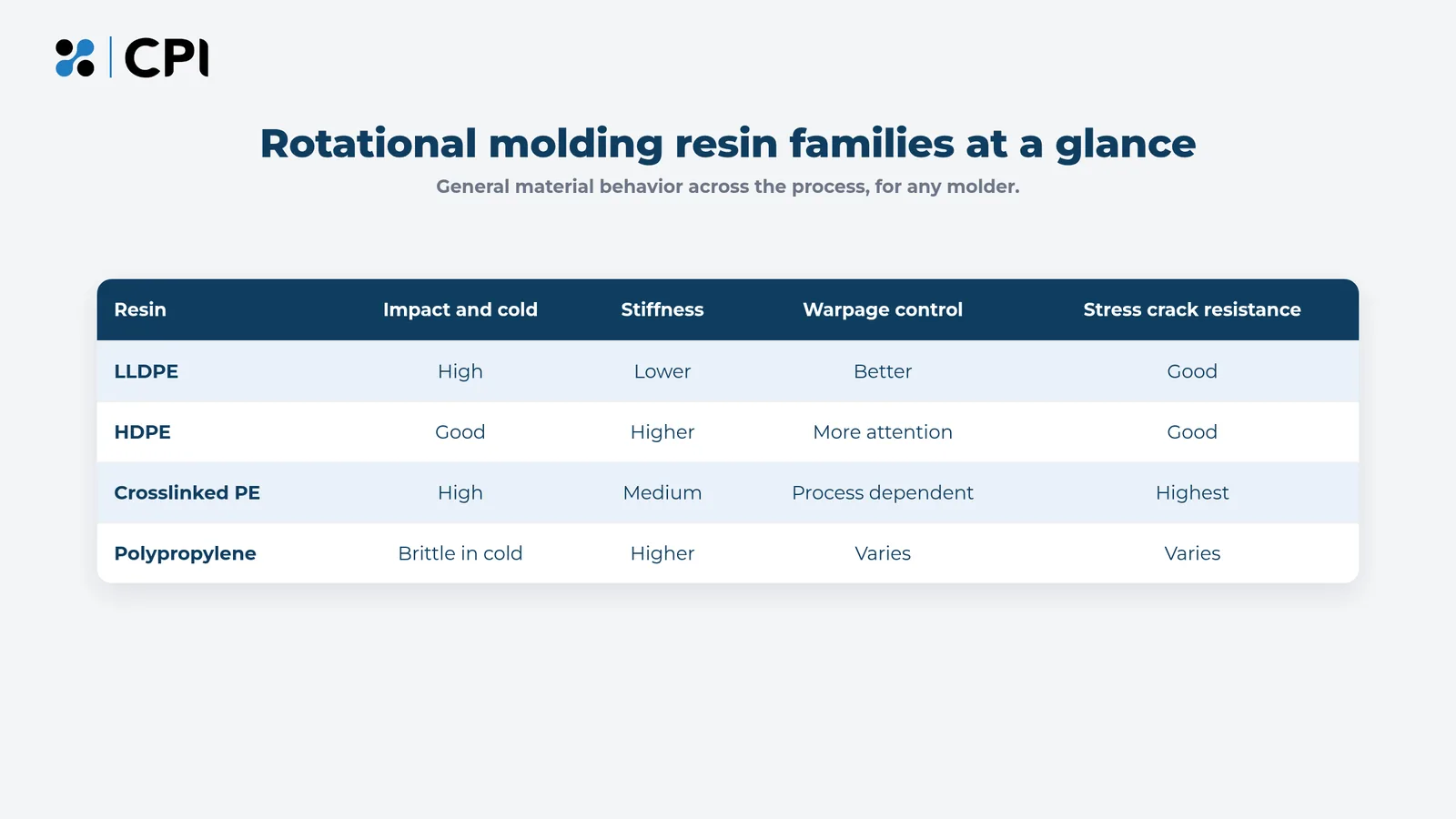
| Resin | Where it fits | Main limits |
|---|---|---|
| LLDPE | Outdoor parts that take impact, large hollow shapes, parts that must stay flat | Lower stiffness, so walls run thicker for the same rigidity |
| HDPE | Stiff panels, containers that hold their shape under load, parts with a stiffness target at thinner walls | More warpage and shrinkage, lower low-temperature impact than LLDPE |
| Crosslinked PE (XLPE) | Large tanks, parts facing chemicals, stress, or hard impact over years | Narrower process window, higher cost, cannot be reground and reused |
| Polypropylene | Parts that see higher temperature or need more stiffness | Brittle at low temperature, harder to mold |
| Nylon | Wear surfaces, fuel and hydrocarbon barrier, high strength | Absorbs moisture, needs dry powder and a protected atmosphere, high cost |
| PVC plastisol | Soft, flexible hollow parts | Liquid process with its own equipment and handling, narrow range of applications |
| Polycarbonate | Clear parts with high impact | Needs drying, difficult to mold, needs UV protection outdoors |
Defined Term: Density
the mass per unit volume of the resin, which for polyethylene sets stiffness, shrinkage and warpage tendency. LLDPE grades sit below roughly 0.940 g/cm³ and HDPE grades sit above it.
Start with LLDPE when impact and flatness matter
LLDPE is the usual first choice. It gives high impact strength, holds up in the cold better than HDPE, and shrinks less, which keeps large parts closer to the drawing. Metallocene LLDPE grades tighten the molecular weight distribution and are often chosen where impact and processing consistency both matter.
Run LLDPE through a stiffness check before you accept it. A flexible resin in a thin wall flexes under load, so the wall thickness that fixes it adds weight and cycle time.
Move to HDPE when the stiffness target controls the design
HDPE is stiffer at the same wall. That allows a thinner wall for a rigid panel or a container that has to hold its shape. The cost is warpage. HDPE shrinks more and less evenly, so flat panels and long unsupported spans need ribs and controlled cooling.
Write the reason into your callout: “HDPE, because deflection under load controls.” A stated reason lets a molder challenge the choice if another route works better.
Specify crosslinked PE when stress cracking or hard service is the problem
Crosslinked polyethylene is built during the heat cycle. A crosslinking agent in the resin forms bonds between polymer chains as the part melts. Those bonds raise resistance to stress cracking, impact and heat.
Defined Term: Crosslinked polyethylene (XLPE)
polyethylene whose polymer chains are chemically linked during molding, giving higher environmental stress crack resistance, impact strength and heat resistance than standard grades. The linked structure means scrap cannot be reground and reused.
Crosslinked grades are common for large chemical and agricultural tanks. Their cycle has a narrower window for oven temperature and time, so cycle control matters more. Our post on process control in rotational molding shows how heat cycle settings affect the finished wall.
Treat polypropylene, nylon, PVC plastisol and polycarbonate as exceptions you must justify
Each of these resins solves one problem and adds several. Polypropylene gives stiffness and heat resistance and turns brittle in freezing conditions. Nylon gives strength, wear resistance and a hydrocarbon barrier, and it absorbs moisture, so the powder has to be dried and the mold atmosphere controlled. PVC plastisol gives soft, flexible parts through a liquid process. Polycarbonate gives clarity and impact and needs careful drying and UV protection.
Before moving off polyethylene, write one sentence naming the requirement that polyethylene fails. If you cannot write it, stay with polyethylene.
How do you choose a rotational molding resin step by step?
Choose the resin by writing the service conditions first and matching them to the resin second. Eight inputs cover almost every selection, and each one ties to a field failure you can name.
Write down the service conditions on one page
List the environment the part lives in: outdoor or indoor, minimum and maximum temperature, chemicals it contacts, loads it carries, and how many years it must last. This page goes to the molder with the drawing.
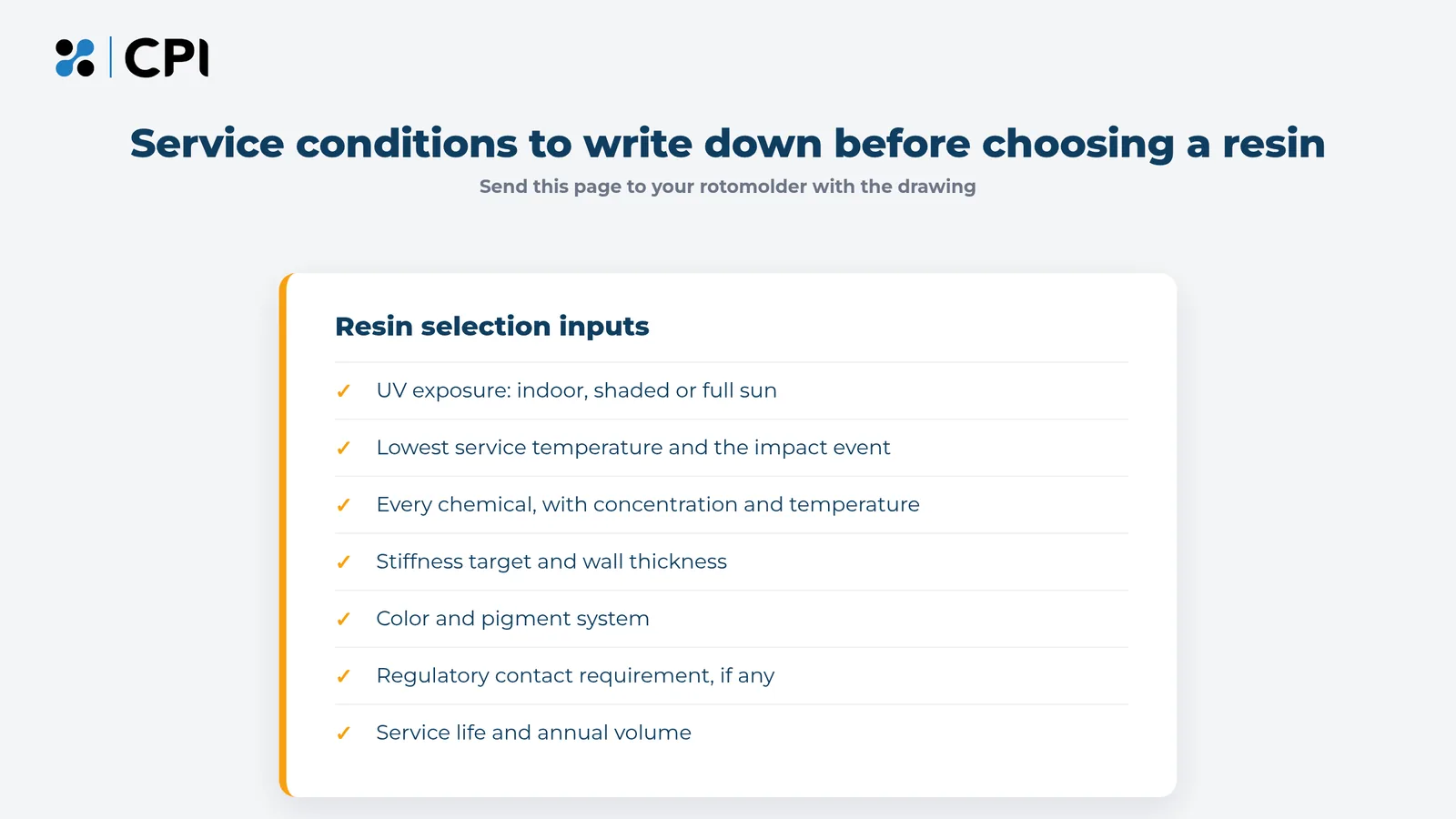
Rank UV exposure from none to continuous
Mark the part as indoor, shaded outdoor, or full sun for its whole life. Full sun sets the stabilizer loading and often the color.
Set the low-temperature impact requirement as a number
Write the lowest service temperature and the impact event the part must survive at that temperature. The Association of Rotational Molders low-temperature impact test is the usual reference, run at -40 degrees. A requirement stated as “tough” cannot be tested.
List every chemical the part touches, with concentration and temperature
Chemical resistance depends on all three. Include cleaning agents, fuels, fertilizers, salt spray and fluids from nearby equipment. Add the temperature the contact occurs at.
Calculate the stiffness the wall has to deliver
Bending stiffness grows with the cube of wall thickness, so a small increase in wall buys a large gain in rigidity. Decide whether the stiffness comes from a stiffer resin, a thicker wall, or ribs and geometry. Cost and weight differ across the three routes.
Choose the color before the grade
Color is a resin decision. Carbon black gives the strongest built-in UV protection. Light colors need more stabilizer to reach the same outdoor life, and pigment loading can change impact strength.
State any regulatory contact requirement up front
If the part touches food, drinking water or medical contents, say so on the first page. Each application carries its own rules for the resin grade and additive package, and the supplier documentation has to support the claim. Raise it before quoting, because it limits the grades available.
Confirm the cost of the grade against the life of the part
A premium grade that doubles a part’s service life can cost less per year in service. Tie the choice to replacement cost, downtime and warranty exposure, and compare on cost per year.
How does UV exposure change the resin choice?
UV exposure changes the resin choice through the stabilizer package, the color, and the wall thickness. Polyethylene degrades under sunlight by oxidation, and the stabilizer is consumed over time, so the part’s outdoor life tracks how much stabilizer it starts with.
Ask the resin supplier for the stabilizer level of each grade and for outdoor exposure data, because stabilizer loading differs from grade to grade. Request a grade built for continuous outdoor service on any part that will sit in sun for years.
The selection rules for UV:
- Full sun for the life of the part: specify a UV-stabilized grade and prefer carbon black or another dark pigment.
- Light color required: accept a lower service life estimate or raise the stabilizer level and ask for exposure data on that color.
- Thicker walls: a thicker wall has more material to lose before the part fails, which extends the point where the surface cracks reach a structural depth.
Our article on why rotomolded parts fail in the field covers how design decisions interact with the material in outdoor service.
How does low-temperature impact affect resin selection?
Low-temperature impact favors LLDPE and crosslinked PE over HDPE, and it rules out polypropylene for many freezing applications. Polyethylene stays tough well below freezing, and polypropylene becomes brittle.
Agricultural equipment, utility fleet components and marine hardware are the usual cases. A feeder or an equipment liner takes impacts when the temperature is lowest and the material is least forgiving.
For the part, take these steps:
- State the lowest service temperature.
- State the impact: dropped tool, collision, ice, or handling.
- Ask for ARM low-temperature impact data on the candidate grade.
- Add wall thickness at the impact zones when the data shows a thin margin.
How do you match a resin to chemical exposure?
Match the resin to chemical exposure by checking each chemical at its concentration and temperature against the resin’s resistance data, then checking stress cracking separately. Polyethylene resists many acids, bases and salts. It swells in some hydrocarbons and solvents, and it is permeable to fuels.
Defined Term: Environmental stress crack resistance (ESCR)
a resin’s resistance to cracking when it is under stress and in contact with a surface-active chemical such as a detergent. ESCR is a separate property from general chemical resistance, and a part can resist a chemical and still crack in it under load.
Use this sequence for any tank, container or part that touches fluid:
- List each chemical with concentration and temperature.
- Check the resin supplier’s chemical resistance chart for each.
- Flag any fluid that acts as a stress crack agent: detergents, some oils and wetting agents.
- Move flagged parts to a higher-ESCR grade or crosslinked PE.
- Add a barrier approach for fuel contact, such as a nylon layer or a different resin, because standard polyethylene lets fuel permeate.
How do you balance stiffness, wall thickness and cost?
Balance them by choosing the stiffness source first, then pricing the three routes: stiffer resin, thicker wall, or geometry. Wall thickness has the strongest lever, because bending stiffness scales with thickness cubed.
| Route | Effect | Cost and process effect |
|---|---|---|
| Stiffer resin (HDPE) | More rigidity at the same wall | More warpage and shrinkage to control |
| Thicker wall | Large gain in rigidity | More resin per part and a longer cycle |
| Ribs, kiss-offs and double walls | Rigidity from shape | Tooling complexity, and the part’s feature design carries the load |
A double-wall design and molded-in ribs let LLDPE hit a stiffness target that a flat single wall would miss. Our post on engineering better performance with rotomolded design covers how geometry carries load.
Which resin should you start with for each application condition?
Start with the resin in the table that matches the controlling condition, then test it against the other columns. The condition that would cause the most expensive failure goes first.
| Controlling condition | Start with | Why | Check before you lock it |
|---|---|---|---|
| Full sun, years of outdoor life | UV-stabilized LLDPE in a dark color | Impact and UV life with low warpage | Stabilizer level and exposure data for the color |
| Freezing temperatures and impact | LLDPE or crosslinked PE | Toughness holds in the cold | ARM low-temperature impact data |
| Large chemical or agricultural tank | Crosslinked PE | Highest stress crack resistance | Cycle control, because the process window is narrow |
| Rigid panel or housing | HDPE | Stiffness at a thinner wall | Ribs, cooling and warpage |
| Fuel or hydrocarbon contact | Barrier approach with nylon or another layer | Polyethylene alone lets fuel permeate | Moisture handling for nylon |
| Elevated temperature in service | Polypropylene | Higher heat resistance than polyethylene | Brittleness at low temperature |
| Clear impact-resistant part | Polycarbonate | Clarity with impact strength | Drying and UV protection |
| Soft, flexible hollow part | PVC plastisol | Flexible walls | Liquid process requirements |
Programs in agriculture, marine and industrial equipment tend to land in the first four rows, because outdoor life, cold impact and chemical contact are the common constraints.
Have a part that has to survive the field?
Send the one-page service conditions for your part and talk through the material before the drawing is released.
How does resin choice affect shrinkage, warpage and tolerance?
Resin choice sets shrinkage, and shrinkage sets the tolerance you can hold. Polyethylene shrinks in the low single-digit percent range as it cools. HDPE typically shrinks more than LLDPE, and the amount varies with wall thickness and cooling rate.
Shrinkage is directional and uneven. Thick areas, corners and unsupported panels move differently, and that movement shows up as warpage. A resin switch from LLDPE to HDPE changes every dimension on the part, so it needs a new look at the tolerance callouts.
Design rules that follow from this:
- Pick the resin before you set the tolerance callouts.
- Treat tolerances on a shrinkage-driven dimension as wider than injection molded parts of the same size.
- Add draft angle and radii so the part releases cleanly after shrinkage.
- Ask for a design review when switching resin on an existing drawing.
The rotomolding vs injection molding post lists the process differences that shape tolerance and design.
What moisture, pigment and powder problems follow a wrong resin choice?
A wrong or poorly handled resin shows up as bubbles, thin spots, color streaks, warped walls and reduced impact. Many of these defects start in material handling or grade choice, and the checks below catch them before molding. Oven settings are the other half of the cause.
| Symptom | Resin-side cause to check |
|---|---|
| Bubbles in the wall | Powder with poor flow, moisture in nylon or polycarbonate, cycle too short for the grade |
| Color streaks or uneven color | Dry-blended pigment that did not mix evenly |
| Low impact in a pigmented part | High pigment loading or poor dispersion |
| Warped flat panel | HDPE shrinkage with insufficient ribbing or uneven cooling |
| Early surface cracking outdoors | Stabilizer level too low for the exposure |
| Cracks at a fluid contact area | Stress crack agent in the fluid with a low-ESCR grade |
Use pre-compounded color when color uniformity or impact is a priority, because dry-blended pigment depends on mixing. Keep nylon and polycarbonate powder dry. Our guide to rotomolding defects goes through causes and prevention in more detail.
When is a specialty resin or another process the better answer?
A specialty resin or another process is the better answer when polyethylene fails a requirement on your service conditions list. Continuous elevated temperature, a fuel barrier, clarity and very high volume are the usual ones. Naming the requirement lets you decide with a reason.
Three situations call for a second look at the whole approach:
- High volume with small parts. Injection molding cycle times and unit costs favor it, as the rotomolding vs injection molding post explains. CPI Products works in rotational molding, so the comparison here is a general process comparison.
- Very tight tolerances on many dimensions. Shrinkage behavior of polyethylene limits how tight rotomolded parts can go, and the process may need secondary operations.
- Thin-walled bottles and containers in volume. Our blow molding vs rotational molding comparison covers where each process wins.
A rotomolder that tells you when rotomolding or a given resin is the wrong answer saves you a tooling cycle. That is the useful input to ask for at the start of a program.
What should you send a rotomolder before the resin is locked?
Send the service conditions page, the drawing, the annual volume, and any regulatory contact requirement. These four items let a molder check the resin against the part and flag problems while the design can still change.
Use this checklist:
- Drawing or 3D model with wall thickness targets.
- Service conditions: UV exposure, temperature range, chemicals, loads, service life.
- Color and finish requirements.
- Annual volume and release schedule.
- Regulatory contact requirements, stated plainly.
- Current resin callout, if any, and the reason it was chosen.
CPI Products designs and rotomolds custom polyethylene parts for aerial lifts, agriculture, marine, automotive, industrial, public safety and waste management programs, and offers prototyping and design support alongside production. Prototypes let you test a resin choice on a physical part before production tooling is committed.
Have a part that has to survive the field?
Bring the service conditions for your part and talk through the material before the resin callout is locked.
About CPI Products
CPI Products is a custom rotational molding manufacturer in Port Washington, Wisconsin, with decades of experience in rotational molding. The team works with OEM design and sourcing engineers from concept and design through production and delivery.
Related posts
- Rotational Molding: A Complete Guide to the Process
- Rotomolding Defects: Causes and How to Prevent Them
- Rotomolding vs. Injection Molding: Process Differences and Design Considerations