
Rotomolding vs. Injection Molding: Process Differences and Design Considerations
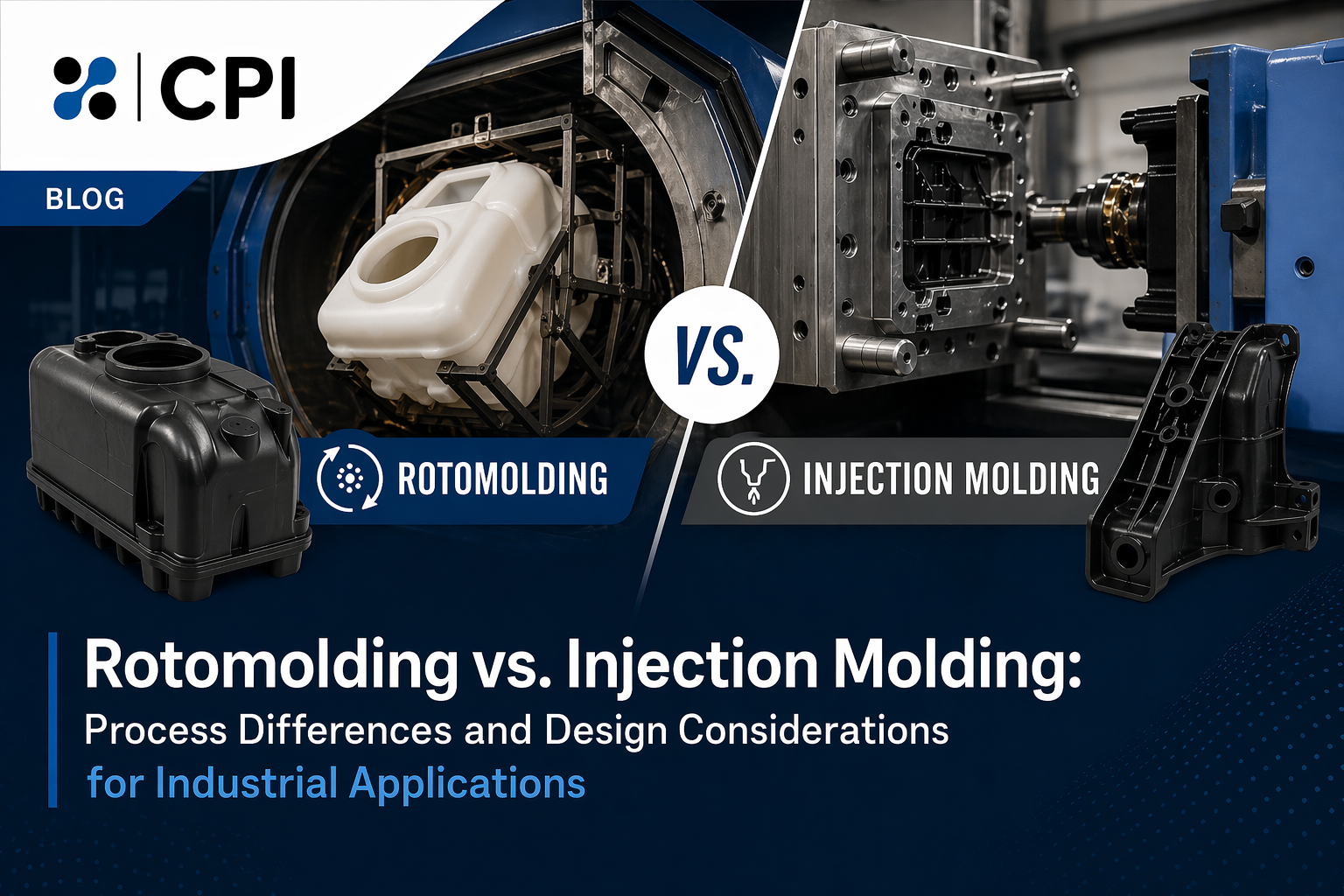
Selecting the appropriate manufacturing process is a critical decision in the design of plastic components for industrial equipment. Among the most commonly evaluated options are rotational molding (rotomolding) and injection molding. While both processes form thermoplastics into finished parts, their underlying mechanics result in very different outcomes in terms of part geometry, material distribution, and performance.
For engineers, understanding these differences is essential to optimizing both design and long-term product reliability.
Process Fundamentals
Rotomolding is a low-pressure, high-temperature process in which a measured quantity of polymer powder, typically polyethylene, is introduced into a mold. The mold is then heated while rotating about two perpendicular axes. As the material melts, it progressively coats the surfaces of the mold, forming a hollow part. Because there is no external pressure driving material flow, the final wall structure is governed primarily by gravity and rotational dynamics.
Injection molding, by contrast, is a high-pressure process in which molten polymer is injected into a closed mold cavity. The material is forced into all areas of the tool, filling complex geometries before cooling and solidifying under controlled conditions. This process relies heavily on flow behavior, pressure gradients, and cooling rates to achieve the desired part characteristics.
These fundamental differences in material distribution and forming forces directly influence design constraints and performance outcomes.
Material Distribution and Structural Integrity
One of the defining characteristics of rotomolding is its ability to produce parts with relatively uniform wall thickness. Because the material is not forced through gates or runners, there are no knit lines, weld lines, or internal stresses caused by flow fronts meeting. This results in a more isotropic structure, which can improve impact resistance and reduce the likelihood of stress-related failure.
Injection molded parts, while capable of achieving tight tolerances and intricate features, are inherently influenced by flow dynamics. Variations in wall thickness, gate placement, and cooling rates can introduce residual stresses, anisotropy, and potential weak points. These factors must be carefully managed through design for manufacturability (DFM) and tooling strategy.
For applications subject to dynamic loading, vibration, or environmental stress, these structural differences can be significant.
Design Constraints and Opportunities
Each process imposes its own set of design rules.
Rotomolding favors geometries that support even material distribution. Sharp internal corners are typically avoided in favor of radii, which promote consistent wall formation. At the same time, the process enables features that are difficult or costly to achieve with other methods, such as double-wall construction, integrated ribs, and thickened corners without sink or void issues.
Injection molding allows for a much higher degree of geometric complexity and precision. Features such as fine details, snap fits, and thin walls are achievable due to the controlled injection of material under pressure. However, these advantages come with stricter requirements around draft angles, uniform wall thickness, and flow path optimization to prevent defects such as warping, sink marks, or short shots.
The selection of process should therefore align closely with the functional and geometric priorities of the component.
Tooling and Production Considerations
Tooling requirements differ significantly between the two processes. Injection molds must withstand high pressures and are typically machined from hardened steel or aluminum, resulting in higher upfront costs and longer lead times. However, once in production, cycle times are short and repeatability is high, making the process well-suited for large production volumes.
Rotomolding tooling generally does not need to withstand high internal pressures. This reduces initial tooling costs and allows for greater flexibility in design changes. Cycle times are longer due to heating and cooling phases, but for low-to-medium volume production, particularly of large parts, the overall economics can be favorable.
From an engineering perspective, these factors often influence not just cost, but also project timelines and scalability.
Application-Driven Performance
In industrial applications such as aerial lifts, agricultural equipment, and material handling systems, component performance is often dictated by environmental exposure and mechanical demands.
Rotomolded parts are commonly selected for these environments due to their ability to withstand impact, resist UV degradation, and maintain structural integrity over time. The absence of seams and internal stresses contributes to longer service life in field conditions.
Injection molded components are more commonly used in applications where precision and repeatability are critical, and where parts operate in more controlled environments. Their strength can be optimized through design, but typically requires more careful engineering to account for stress concentrations and material behavior.
Engineering Trade-Offs
Ultimately, the choice between rotomolding and injection molding is a matter of balancing trade-offs.
Rotomolding offers advantages in structural uniformity, impact resistance, and tooling cost for larger, hollow components. Injection molding provides unmatched efficiency and precision for high-volume production of smaller, complex parts.
Early collaboration between design and manufacturing teams is essential to ensure that the selected process aligns with both performance requirements and production constraints.
Rotomolding and injection molding are fundamentally different processes, each optimized for specific types of applications. For engineers, the key is not determining which process is better, but which is more appropriate given the functional, environmental, and economic requirements of the component.
A clear understanding of material behavior, process limitations, and design implications will lead to better decisions, and ultimately, more reliable products in the field.
Partner with CPI for Rotomolded Solutions That Perform
At CPI Products, we work closely with your team to ensure developed rotomolded components meet the demands of real-world industrial applications. From initial design considerations through production, our focus is on ensuring consistent material distribution, structural integrity, and long-term performance.
Whether you are evaluating process options or refining an existing design, our team brings the experience needed to support durable, manufacturable solutions.
Contact CPI to discuss your application and explore how rotomolding can support your design objectives.