
Why Aerial Lift Manufacturers Are Switching to Rotomolded Bucket Liners and Components
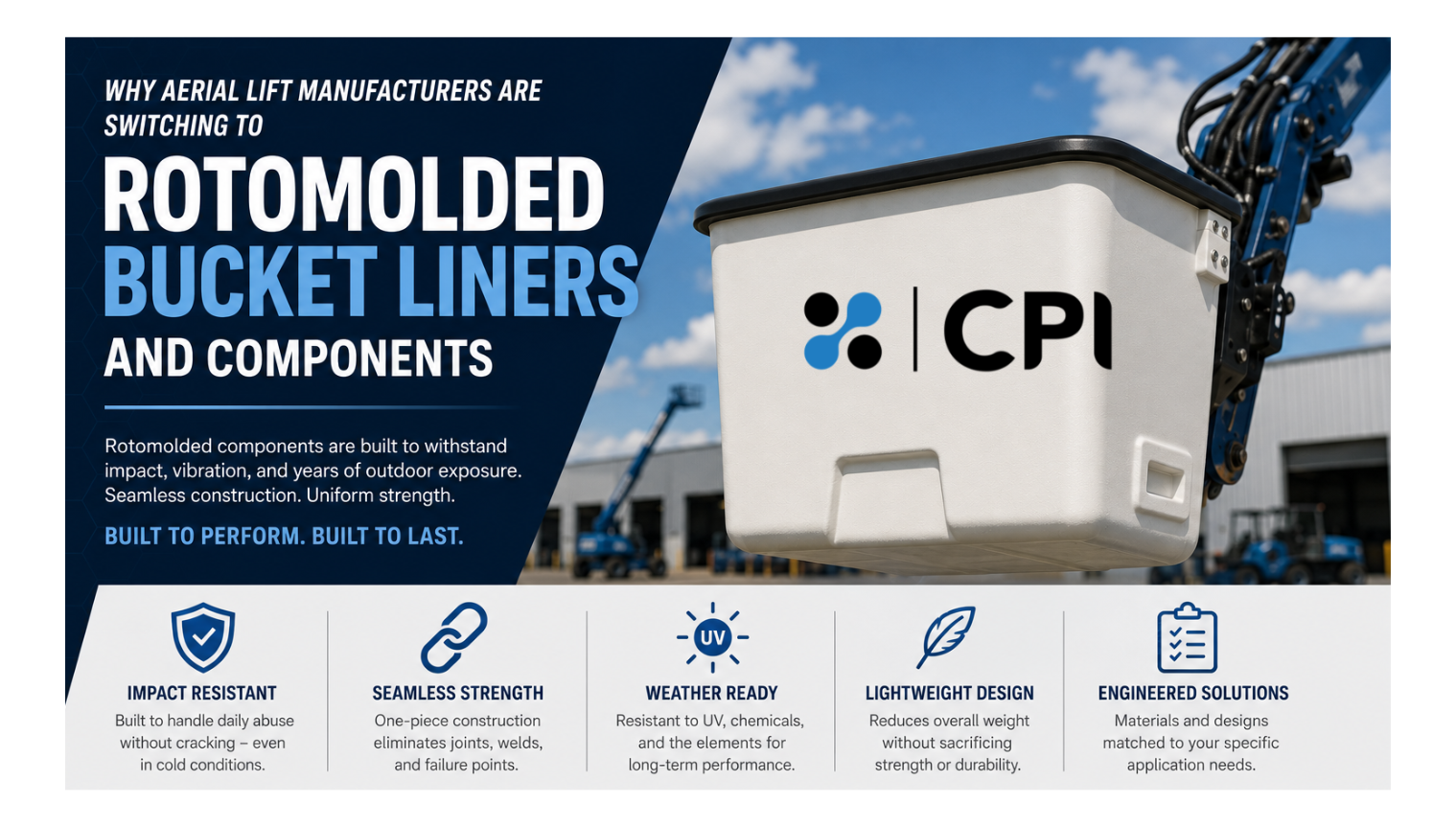
Rotational molding produces bucket liners, aerial lift components, enclosures, and protective housings as a single seamless piece, with no thin corners or weak transition points where the material coats a mold unevenly. That uniformity is what gives rotomolded parts their impact resistance and long-term reliability in equipment that spends its working life absorbing vibration, shock, and constant weather exposure. For aerial lift manufacturers evaluating a molding partner, that combination of durability and design flexibility is the case for rotomolding over welded metal or laid-up fiberglass.
What Makes Rotational Molding a Better Fit for Aerial Lift Components Than Metal or Fiberglass?
Aerial lift components take on the same stresses no matter the material: repeated impact, vibration, and years of outdoor exposure. Rotomolded parts are well known for their ability to absorb impact without cracking, even in cold conditions where other plastics can become brittle, because the molding process introduces minimal internal stress during manufacturing. That means the part retains its toughness over time rather than degrading the way a weld point fatigues or a fiberglass layup delaminates.
Because the material evenly coats the interior of the mold, a rotomolded liner or housing has no thin corners or weak transition points the way a stamped or welded metal part does. For components that experience vibration, off-axis loads, or repeated use, that uniform wall thickness directly contributes to longer service life and reduced maintenance.
Seamless Construction Removes the Failure Points Other Methods Introduce
Rotational molding produces hollow, seamless products without the joints or seams that other manufacturing methods rely on, and those joints are often the weak points in a product. A cover or housing molded as one piece has no weld to crack and no fastener to work loose under thousands of boom cycles.
Material Selection Matched to the Application
CPI offers a range of materials suited to different performance needs. High-density polyethylene (HDPE) is commonly used for its strength and resistance to impact, UV degradation, and chemicals. Linear low-density polyethylene (LLDPE) is used where flexibility and resistance to stress cracking matter more. Choosing between them is a material selection decision specific to how a given liner, cover, or housing will actually be loaded and flexed in service.
How Does CPI Control for Consistent Wall Thickness and Structural Integrity?
Precision in rotomolding comes down to process control: managing temperature, cycle time, rotation, and cooling through every stage of the mold cycle. Mold wall temperatures for most polyethylene-based resins run between 260°C and 370°C (500°F to 700°F) depending on formulation. Underheating leaves incomplete fusion and weak areas or pinholes; overheating causes degradation, brittleness, and discoloration. According to the Association of Rotational Molders, advanced temperature monitoring has reduced reject rates industrywide by up to 20% compared to manual control.
Rotation is the other variable that determines wall consistency. Molds spin on two axes simultaneously, typically at speed ratios of 3:1 to 8:1, and getting that ratio wrong for a given part’s geometry creates thin or voided sections. Every part that comes out of CPI’s process undergoes testing for strength, dimensional accuracy, and environmental resistance before it’s considered finished, which is the quality assurance step that catches inconsistency before a part ships.
What Design Features Actually Matter When Specifying Aerial Lift Bucket Liners and Covers?
Consistent wall thickness. This is the single biggest driver of whether a liner or cover holds up under repeated impact. Uneven material distribution during molding is what creates the thin spots that fail first.
Material matched to how the part will flex or take impact. HDPE for parts that need to resist impact, UV, and chemical exposure without flexing. LLDPE where the part needs to flex without stress cracking.
Design that eliminates secondary assembly. A part molded with mounting features and pass-throughs built into the original design removes the drilling, bracketing, and fastening that other manufacturing methods require after the fact, along with the new failure points those steps introduce.
What Objections Come Up Before an OEM Qualifies a New Molding Partner?
“Plastic can’t take the abuse our current metal or fiberglass components handle.” Rotomolded HDPE and LLDPE parts are engineered specifically for impact resistance without cracking, including in cold conditions, and the seamless construction removes the weld or fastener failure points that metal and fiberglass parts are prone to over time.
“We’d be locked into custom tooling costs we can’t justify for our production volumes.” Rotational molding uses molds that cost significantly less than injection tooling, which is specifically why it fits custom or limited-run production instead of requiring the volumes injection molding needs to pay off.
“Qualifying a new supplier means lead time risk and inconsistent parts.” This is a fair concern with any supplier change. It’s also the reason the design and material selection conversation upfront, reviewing exactly what a part needs to withstand and choosing the resin accordingly, matters more than the switch itself.
What This Looks Like in Practice
An engineer sourcing a molded liner, cover, or housing for a bucket assembly works from the part’s actual requirements: the dimensions it needs to fit, the impact and environmental exposure it needs to survive, and the material that matches those demands. That’s the information CPI’s team works through directly with a customer, from initial concept through final production, to land on a design and material choice before committing to a production run.
Talk to CPI About Your Aerial Lift Component Needs
If you’re evaluating rotomolded liners, covers, or housings for aerial lift equipment, the fastest way to get a straight answer on fit, material, and lead time is to bring CPI your dimensions and requirements directly. Get in touch to start that conversation before you commit to a production run.