
Rotomolding in Industrial Applications: Performance, Durability, and Engineering Insight
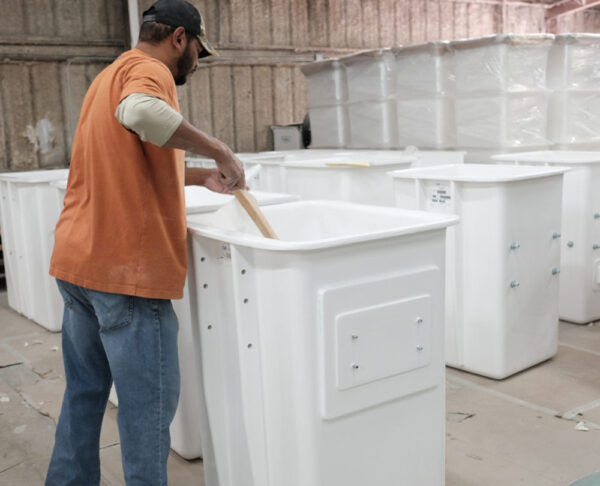
In industrial manufacturing, material choice and process selection directly affect performance, safety, and lifecycle cost. Rotational molding, commonly known as rotomolding, has earned its place as a trusted manufacturing method for demanding applications because it delivers consistent, durable parts designed to perform in real-world conditions.
As industries continue to push equipment harder and expect longer service life from components, understanding why rotomolding works and where it excels has become increasingly important.
What Is Rotomolding and Why Does It Matter?
Rotomolding is a low-pressure molding process used to produce hollow plastic parts with exceptional structural integrity. Unlike injection molding or thermoforming, rotomolding relies on heat and rotational movement rather than pressure, allowing material to coat the mold evenly.
This process creates parts with:
- Uniform wall thickness
- No internal stress points
- Excellent impact resistance
- Consistent performance across production runs
For industrial applications such as rotomolded bucket liners, aerial lift components, enclosures, and protective housings, these characteristics are critical to long-term reliability.
Uniform Wall Thickness for Predictable Engineering Performance
One of the most significant advantages of rotomolding is uniform wall thickness. Because the material evenly coats the interior of the mold, there are no thin corners or weak transition points.
From an engineering perspective, this uniformity results in:
- Improved load distribution
- Reduced cracking and deformation
- Greater resistance to fatigue
- More predictable part behavior under stress
For components that experience vibration, off-axis loads, or repeated use, uniform wall thickness directly contributes to longer service life and reduced maintenance.
Impact Resistance Built for Industrial Environments
Industrial job sites expose components to constant physical stress, impacts, abrasion, temperature swings, and environmental exposure. Rotomolded parts are well known for their ability to absorb impact without cracking, even in cold conditions where other plastics can become brittle.
Because rotomolding introduces minimal internal stress during manufacturing, parts retain their toughness over time. This makes rotomolded components ideal for equipment that must remain reliable in unpredictable environments.
Design Flexibility Without Compromising Strength
Rotomolding offers a high degree of design freedom while maintaining structural integrity. Engineers can incorporate features such as:
- Molded-in ribs and reinforcement
- Integrated mounting points
- Internal channels or contours
- Variable wall thickness where additional strength is required
These features can often be produced as a single, seamless part, reducing the need for secondary operations or assemblies. Fewer joints and fasteners mean fewer potential failure points in the field.
Material Selection That Supports Long-Term Performance
Most industrial rotomolded parts are produced using high-performance polyethylene materials selected for strength, UV resistance, chemical resistance, and environmental durability.
Material selection plays a major role in how a part performs over its lifecycle. When matched correctly to the application, rotomolded components can withstand prolonged exposure to weather, electrical environments, and harsh jobsite conditions without sacrificing performance.
Why Manufacturing Expertise Matters in Rotomolding
While rotomolding is a proven process, consistent results depend heavily on manufacturing expertise. Tooling design, material handling, cycle control, and quality inspection all influence final part performance.
An experienced rotomolding manufacturer understands how design decisions translate to real-world outcomes, helping ensure parts meet performance expectations not just on paper, but in the field.
The Role of Rotomolding in Modern Industrial Design
Rotomolding continues to evolve alongside industrial equipment design. Its ability to produce durable, lightweight, and highly consistent parts makes it an essential process for manufacturers seeking long-term reliability and cost efficiency.
As applications become more demanding, rotomolding remains a manufacturing method that engineers, fleet managers, and designers can rely on.
Industry Knowledge You Can Trust
Rotomolding is more than a manufacturing capability; it’s a core area of expertise. With decades of experience supporting industrial applications, CPI Products focuses on sharing practical, engineering-driven knowledge that helps customers make informed decisions about materials, design, and manufacturing methods.
Whether you’re evaluating rotomolded bucket liners, aerial lift components, or other industrial parts, understanding the process behind the product is key to long-term success.