
What Happens Inside a Rotomold? Why the Process Matters for Aerial Lifts and Industrial Equipment
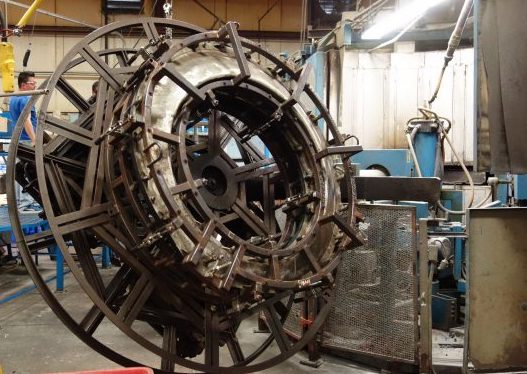
When you look at a finished rotomolded part, whether it’s a housing for aerial lift equipment, a durable enclosure for industrial machinery, or a component used in marine or agricultural environments, you’re seeing the result of a process that’s largely invisible.
But that unseen process is exactly what determines how well that part performs in the real world.
Rotational molding is often simplified as a process where plastic resin is heated and rotated inside a mold until it forms a hollow shape. While that’s accurate at a high level, it leaves out what really drives part quality: how the material behaves throughout the cycle, and how precisely that behavior is controlled.
Inside the mold, resin transitions from powder to liquid while the mold rotates on multiple axes. As it melts, it begins coating the interior surface. The goal is not just to form a shape, but to form it evenly, consistently, and with the structural integrity required for demanding applications.
That outcome depends on several variables working together at the same time:
- Heat must be applied evenly and at the right rate
- Rotation speed must support consistent material distribution
- Material must melt and flow at the correct stage in the cycle
- Mold design must allow for proper coverage and wall formation
If any one of these factors is off, even slightly, it can lead to issues like thin walls, warping, or weak points, problems that may not be visible immediately but will show up in performance over time.
Why This Matters for Aerial Lifts and Industrial Equipment
In industries like aerial lifts, industrial equipment, and public safety, rotomolded parts are often more than cosmetic. They serve a functional purpose.
They may act as:
- Protective housings for controls or components
- Enclosures exposed to outdoor environments
- Storage or fluid containment solutions
- Structural covers that must withstand repeated use
These parts are expected to perform in environments that include UV exposure, temperature fluctuations, and mechanical stress. That level of durability is one of the key advantages of rotational molding, but only when the process is properly controlled.
For example, inconsistent material distribution inside the mold can result in:
- Reduced impact resistance
- Uneven wall thickness
- Premature wear in high-stress areas
For equipment like aerial lifts, where reliability and safety are critical, those inconsistencies aren’t acceptable. That’s why process control isn’t just a manufacturing concern. It’s a product performance issue.
The Challenge: You Can’t See Inside the Mold
One of the defining characteristics of rotational molding is that the process happens entirely out of view.
There’s no real-time visibility into how the material is flowing or coating the mold. That means manufacturers have to rely on a combination of:
- Proven cycle parameters
- Material knowledge
- Experience with similar part geometries
Success comes from understanding how all of these variables interact before production even begins. It’s about predicting outcomes, not reacting to them.
As Designs Get More Complex, So Does the Process
Many of the industries CPI supports, such as waste management, agriculture, automotive, and marine, require more than simple hollow parts. They require components that meet specific structural and functional demands.
As designs become more complex, maintaining consistency inside the mold becomes more challenging. Irregular shapes, integrated features, and performance requirements all influence how material flows during the molding cycle.
This is where early engineering involvement becomes critical. Design decisions directly impact manufacturability, and small adjustments can significantly improve material distribution and overall part performance.
Material Behavior Drives Real-World Performance
The type of material used in rotational molding plays a major role in both the process and the final product.
Different resins behave differently in terms of:
- How they melt
- How they flow
- How they respond to environmental conditions
For example, parts used in marine and outdoor recreation applications must handle moisture and UV exposure, while components for industrial and agricultural equipment may need to withstand impact, abrasion, or chemical exposure.
The way these materials behave inside the mold directly affects:
- Strength
- Durability
- Long-term reliability
In other words, material selection and process control are closely connected. You can’t optimize one without understanding the other.
Why Rotational Molding Is a Strong Fit for CPI’s Core Industries
When the process is well-controlled, rotational molding offers several advantages that make it ideal for industries like aerial lifts and industrial equipment.
It allows for:
- Seamless parts with no welds or joints, reducing failure points
- Consistent wall thickness for improved strength and durability
- Flexibility in design, supporting complex shapes and integrated features
- Reliable performance in harsh outdoor and industrial environments
These benefits are why rotomolding continues to be a preferred solution for applications where durability and longevity matter.
Our Approach: Controlling the Process from the Inside Out
At CPI, rotational molding is treated as a process that requires active control, not a commodity manufacturing method.
That approach includes:
- Getting involved early in the design phase to support manufacturability
- Working closely with mold manufacturers to achieve desired outcomes
- Refining processing techniques based on real-world application demands
Because ultimately, the quality of the final product is determined long before it’s removed from the mold.
What You Don’t See Is What Matters Most
For industries like aerial lifts, industrial equipment, marine, and agriculture, performance isn’t optional; it’s expected.
And that performance starts inside the mold.
While the process itself isn’t visible, its impact is. Every decision made during the molding cycle influences the strength, consistency, and reliability of the final product.
That’s why understanding what happens inside a rotomold and working with a team that knows how to control it makes all the difference.